
Off-Plan vs. New Build vs. Resale Property in Montenegro

Buying property in Montenegro is one of the most exciting moves you can make, whether you’re looking for a seaside retreat, a steady rental income, or a high-yield investment asset. But early in the process, every buyer hits the same crossroads:
Should you buy a new build, an off-plan development, or a pre-owned resale home?
I asked Olga Lakomchenko, an experienced real estate manager. She helped me break down what these property categories actually mean in Montenegro’s unique market.
Most people treat the choice between new build, off-plan or resale as a simple matter of personal taste or building age. But your choice shapes everything: how much cash you need upfront, your tax bill, your risk exposure, when you can move in, and, most importantly, how your money works for you over time.
To make the right choice, you first need to match the property type with your actual investment objective:
- Lifestyle & Relocation: You need a move-in-ready home today or within a specific timeframe aligned with your planned move.
- Rental Yield: You are looking for a property that will deliver a stable income stream from short-term or long-term rentals.
- Capital Growth & Value Preservation: You want to buy at the lowest starting price, capture construction appreciation, and maximize resale ROI down the road.

Plan Your Property Investment
With My Trusted Resources
– Make money transfers for less with: Wise
– Book your flights and hotels: Trip.com
Booking.com
– Book your airport transfers here: Kiwitaxi
– Rent cars here: DiscoverCars & LocalRent
– Hire affordable shipping services here: Eurosender
Table of Contents
What Are You Really Buying?
Before comparing Montenegro property prices or views, let’s get clear on definitions. Montenegro real estate categories don’t always mean what foreign buyers expect.
Off-Plan Property (Under Construction)
Buying off-plan means purchasing a unit before or during its construction phase. You are securing an asset based on architectural blueprints, 3D visualizations, and official legal documentation.
Driven by growing demand for modern coastal apartments, construction activity over the past five years has accelerated significantly. A wide array of local and international developers successfully operates in the market, offering a broad selection of modern residential projects ranging from economy to premium.
- The Common Myth: Many buyers think off-plan is just “buying a dream and a developer’s promise.”
- The Reality: In Montenegro, off-plan sales are governed by a strictly regulated legal framework. A developer cannot legally launch sales without an official building permit (građevinska dozvola) issued as a formal administrative decision by the local municipality or the Ministry, an approved main project (glavni projekat), verified land ownership, settled municipal utility fees (komunalije), and the formal notice of commencement (prijava početka građenja). Make sure you verify all required legal documentation before signing a contract; developers should readily provide copies for the buyer’s review.
New Build (Completed Construction)
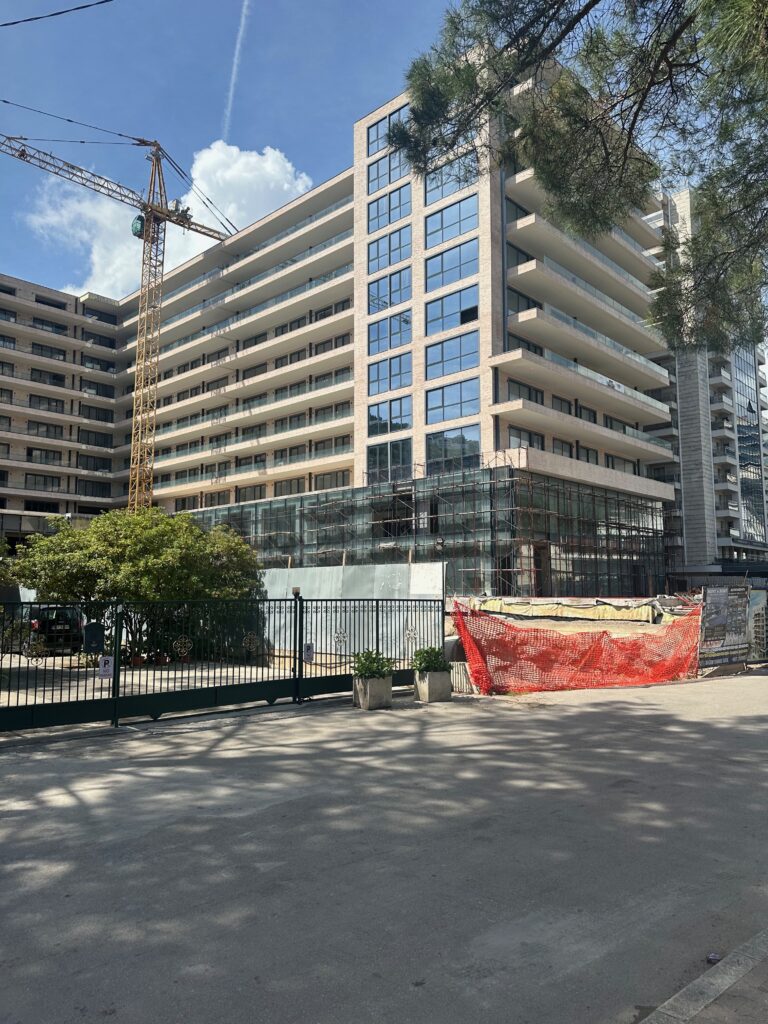
A new build refers to a recently completed property where construction is finished or virtually complete.
- The Local Nuance: Don’t assume every new build is sold directly by the developer. In Montenegro, it is very common for units in brand-new buildings to be sold by landowners (who received apartments as land compensation), contractors (paid in equity), or early investors who bought off-plan and are now liquidating their profit. In fact, most developers aim to sell out all units well before project completion. By the final stages of construction or shortly after its completion, most (if not all) units are typically sold out.
Secondary Market (Resale / Pre-Owned Property)
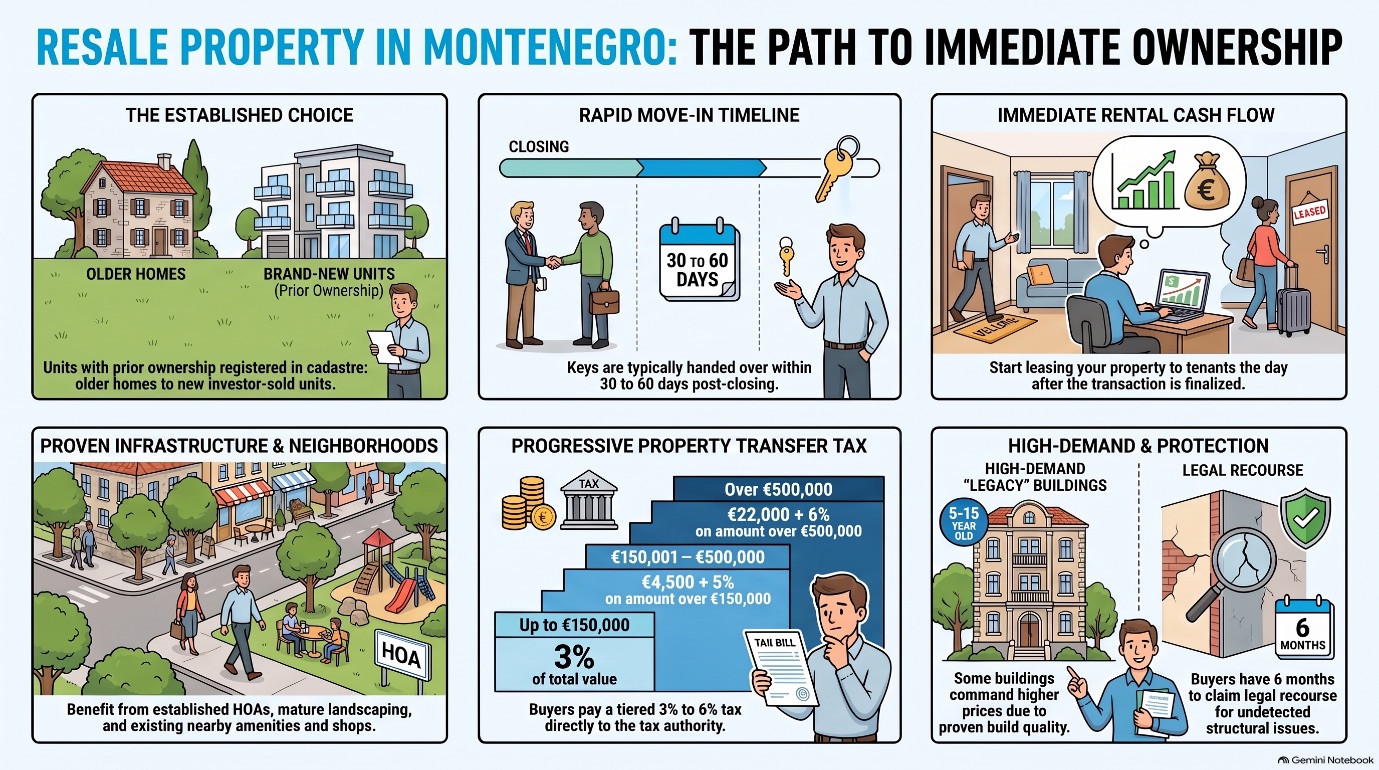
Resale properties are units that have a prior ownership title registered in the cadaster.
- The Local Nuance: “Pre-owned” does not necessarily mean “old or lived-in.” Montenegro’s market features many apartments bought 5 to 10 years ago purely as speculative investments that have remained completely unfurnished and unoccupied. Physically, you are buying a brand-new space from a developer’s original delivery, but legally, it trades on the secondary market. In some cases, this category overlaps with new builds, for instance when early buyers resell newly constructed units unfurnished or in turnkey condition.
| Property Category | Physical State | Primary Seller | Risk Profile |
| Off-Plan | Blueprints / Active Construction | Primary Developer | Managed Risk (tied to construction timeline) |
| New Build | Finished / Near-finished building | Developer, Landowner, Contractor, or Early Investor | Low (What you see is what you get) |
| Secondary Market | Existing building (Any age) | Private Owner / Investor | Low Physical Risk (Subject to technical checks) |
Off-Plan Realities: Capital Appreciation & The First-Mover Advantage
If off-plan requires waiting for your keys, why is it one of the most popular buying strategies in Montenegro? The answer comes down to two factors: capital growth and unit selection.
The Capital Growth Engine
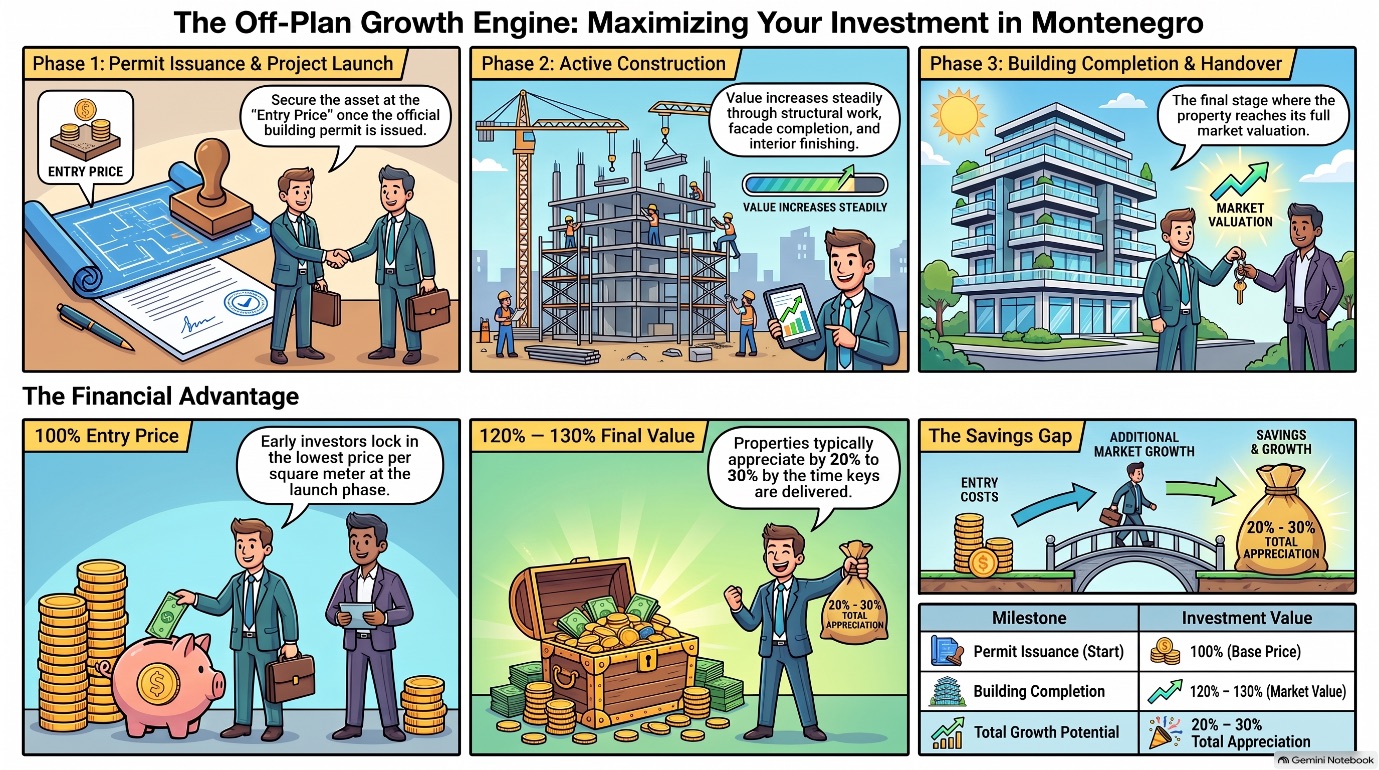
When you buy off-plan at the launch phase (right after the building permit is issued), you lock in the lowest price per square meter. As construction progresses through structural work, facade completion, and interior finishing, the property’s market value increases.
- On average, the price gap between the initial off-plan phase and building delivery is around 20%.
- When combined with overall regional market growth, early investors frequently achieve total capital appreciation of 25% to 30% by the time keys are handed over.
The First-Mover Advantage
When a building is finished, you are left choosing from whatever units remain on the market. Buying off-plan gives you first pick of the developer’s inventory:
- You can select prime floor plans, optimal solar orientation, and unobstructed sea or mountain views.
- You get access to small, highly liquid layouts (studios and compact one-bedroom units), which are the first to sell out among local and international investors. By the time a project is completed, these high-yielding micro-units are almost impossible to buy on the primary market, forcing buyers onto the resale market at higher prices plus the progressive property transfer tax.
Managing Timeline Expectations
Off-plan offers strong capital upside, but you need to stay flexible on timing. Construction timelines following the issuance of a building permit usually range from 2 to 3 years. The larger the project, the longer the timeframe.
In Montenegro, completion schedules depend not only on construction technology and supply chains, but also on seasonal construction bans in tourist zones and the timing of municipal utility connections.
Standard development contracts typically allow developers a 6-month grace period to complete construction without incurring legal penalties, and developers frequently utilize this window.
Pro Tip: Before buying off-plan, evaluate the developer’s historical track record across previous projects. Consistent developers usually deliver on time, while those with a history of delays tend to repeat their patterns.
What You Really Pay: Payment Schedules, Tax Structures & Hidden Costs
When you evaluate property costs in Montenegro, looking solely at the listing price per square meter is a dangerous trap. Your purchase terms, tax exposure, and ongoing ownership obligations shape the true financial picture.
Payment Terms & Cash Flow Control
- Off-Plan: Offers the most flexible cash flow. Most off-plan transactions require a 30% initial down payment at contract signing. The remaining installments are usually tied to key construction milestones: e.g., completion of the rough structure, installation of joinery, interior finishing. These payments can reach up to 50-70% during construction. The rest of the balance is due upon key handover. Some developers offer even more flexible payment structures starting at a 10% down payment, while others may require up to 50% upfront.
- New Build & Resale: Require a full lump-sum payment upon closing (or brief deferred arrangements while final title transfer procedures are completed). Legally, the buyer officially acquires ownership title only after full payment is made. However, in many deals, structured partial payments can be negotiated, giving the buyer a window of a few months to settle the balance in full.
The Tax Breakdown: VAT vs. Progressive Transfer Tax
Tax structure is one of the biggest cost differentials between primary developer stock and resale properties:
- 21% Value Added Tax (VAT / PDV): Applies exclusively to new builds and off-plan properties bought directly from corporate developers on their first sale. The listing price from reputable developers usually includes VAT, but you should always confirm this upfront. In formal sales contracts with developers, VAT is explicitly included in the total price and remitted directly by the developer.
- Progressive Property Transfer Tax (Porez na promet nepokretnosti): Applies to all secondary market (resale) transactions, as well as purchases from non-VAT-registered entities. The buyer pays this tax directly to the Tax Administration post-purchase. Montenegro uses a progressive tax scale based on property valuation:
| Property Purchase Price | Progressive Tax Rate |
| Up to €150,000 | 3% of the total value |
| €150,001 – €500,000 | €4,500 + 5% on the amount exceeding €150,000 |
| Over €500,000 | €22,000 + 6% on the amount exceeding €500,000 |
Two Critical Extras Every Buyer Must Factor In
Underground Parking Provisions
On the Montenegrin coast, parking isn’t a nice extra. It plays a big role in how easily you can resell the property and keep tenants long-term.
- Off-Plan / New Build: Developers almost always offer the option to purchase dedicated spaces in an underground garage (or occasionally include dedicated surface parking).
- Resale Market: Buying a secondary home without a dedicated garage space can lead to acute seasonal parking problems. Tenants heavily prioritize properties with guaranteed parking, especially in dense urban hubs like Budva, Kotor, Tivat, and central Bar.
Monthly Building Maintenance Fees
By Montenegrin law, apartment owners are required to contribute to a communal maintenance fund (investiciono održavanje).
- Basic Stock: Legal minimum starts at €0.20 per m² per month for standard residential buildings with basic cleaning and lighting.
- Resort & Luxury Complexes: In developments offering shared amenities (swimming pools, SPA centers, private gyms, landscaped grounds, 24/7 security, and concierge services), maintenance fees range from €1.00 to €3.50+ per m² per month.
Assessing Resale vs. New Builds: Technical Realities & Hidden Pitfalls
With a resale home, you can walk through it before you buy. But it may have structural or design problems that a fresh coat of paint won’t fix.
The Pitfall of Older Secondary Stock
A common buyer mistake is thinking, “I’ll buy an older apartment for cheap and spend €10,000 on new floors and paint.”
While you can modernize your interior, you cannot individually fix communal building issues. Older buildings, especially those lacking organized building management, frequently suffer from:
- Worn-out communal water and drainage risers prone to leaks.
- Outdated electrical distribution boards and insufficient power allocations.
- Deteriorating roof structures and unmaintained facades.
- Lack of elevators, clean entrance foyers, or modern access control systems.
I saw this first-hand when I renovated my own resale apartment near Budva.
💡 The Renovation Paradox
Individual Interior Renovation (Fresh Paint & New Tiles)
≠
Communal Building Quality (Decaying Risers, Leaky Roofs, or Missing Elevators).
A luxury cosmetic finish inside your apartment will never compensate for deteriorating common infrastructure.
Essential Technical Upgrades for Resale Homes
If you buy an older resale property, budget for technical upgrades specific to Montenegro’s coastal climate:
- Humidity & Mold Control: Coastal humidity often requires retrofitting decentralized ventilation systems with heat recovery (recuperators).
- Thermal & Acoustic Insulation: Replacing drafty windows and adding internal soundproofing.
- Climate Control: Installing energy-efficient multi-split HVAC systems or underfloor heating (where electrical capacity permits).
The “High-Demand Legacy Buildings” Exception
Not all resale property is created equal. Montenegro has a distinct market segment of “legacy residential developments”. They are buildings constructed 5 to 15 years ago by top-tier developers in prime locations with active, well-funded HOAs (Homeowners Associations).
Because of their proven structural quality, maintained facades, premium locations, and established reputation, apartments in these developments often command higher per-square-meter prices than brand-new average construction.
Buyer Legal Rights: Protection Against Hidden Defects
What happens if you buy a resale property and discover severe structural issues post-closing?
Under the Montenegrin Law on Obligations (Zakon o obligacionim odnosima), buyers have statutory protections against hidden technical defects (skriveni nedostaci) that could not be detected during a standard visual inspection.
If a hidden defect is identified and proven within statutory time limits (within 6 months of discovery), the buyer has the legal right to demand:
- Free rectification of the defect by the seller.
- A proportional reduction in the purchase price.
- Withdrawal of the purchase contract with a full refund in severe cases.
Location Dynamics & Spatial Urban Planning (DUP/PUP)
A beautiful apartment in the wrong location or in a location with unpredictable future development can severely undercut your investment returns. When you analyze Montenegro’s real estate market, you must evaluate location through two distinct lenses: rental strategy alignment and municipal spatial planning.
Matching Location & Format to Your Rental Strategy
Don’t fall into the trap of assuming any coastal property will generate high rental yields year-round. Yields depend on matching your property type to the target tenant pool:
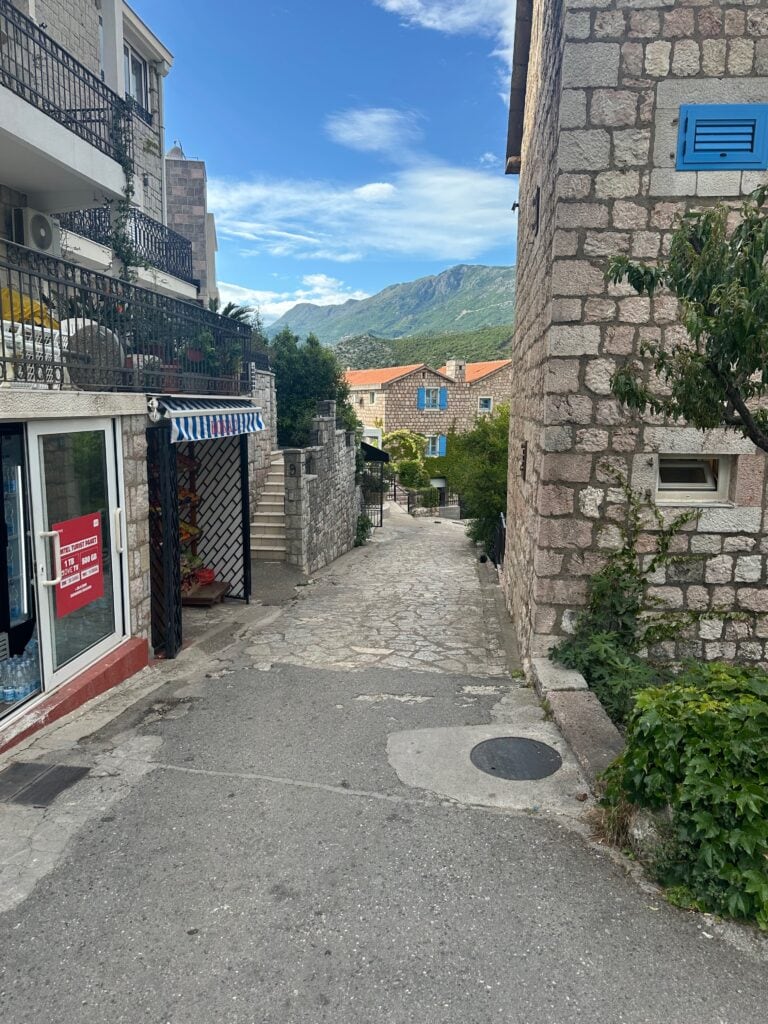
- Short-Term Tourist Rentals: Thrives along the immediate coastal frontline, in or near historical Old Towns (Kotor, Budva, Herceg Novi), and in established resort micro-locations. High gross yields during peak summer (June-September), but expect lower occupancy during the off-season.
- Long-Term Year-Round Rentals: Requires close proximity to urban infrastructure like schools, medical centers, supermarkets, banks, and administrative offices. Towns with active year-round economic life (Bar, Podgorica, central Tivat) offer stable long-term cash flow with low vacancy rates.
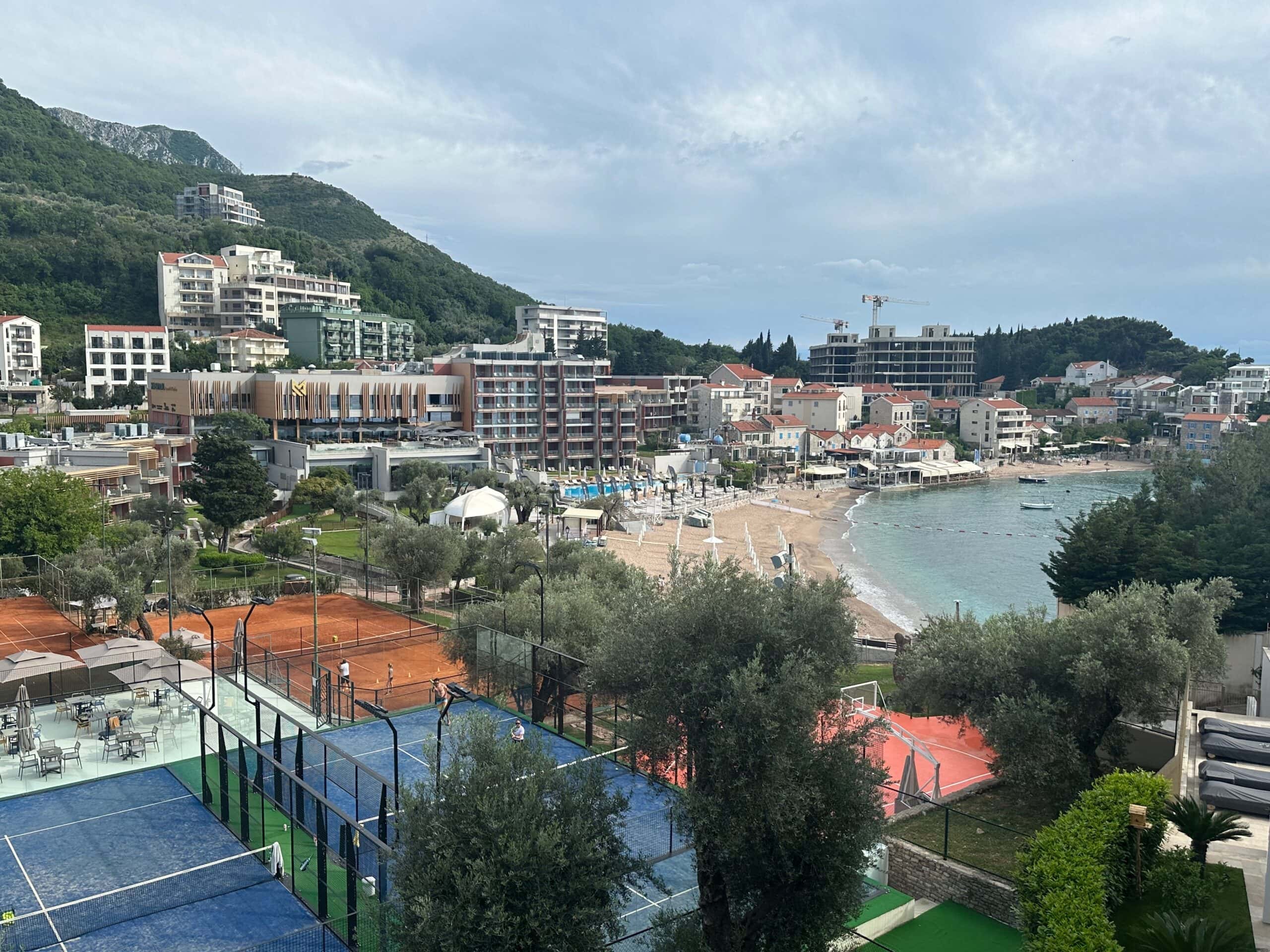
- Luxury & Resort Segment: Concentrated in integrated mega-marina developments (Porto Montenegro in Tivat, Portonovi in Kumbor, Luštica Bay) and prime high-end residences in Central Budva. These assets command premium rental rates and attract international HNWIs, but require higher entry capital.
Evaluating Municipal Master Plans: Protecting Your View and Asset Value
When you buy property in Montenegro, especially in growing coastal areas, you must look beyond what the neighborhood looks like today. You need to verify what it will look like in 5 to 10 years.
Urban development in Montenegro is governed at state and municipal levels by spatial planning documents:
- PUP (Prostorno-urbanistički plan): The municipal spatial-urban plan defining general land-use zones across the entire municipality.
- DUP (Detaljni urbanistički plan): The detailed urban plan that dictates exact building parameters for specific plots. This includes permitted floor counts, maximum gross building area, occupancy indices, and road access.
Spatial Planning Verification Checklist:
[Plot Urbanization Status] ──> [Permitted Floor Levels] ──> [Neighboring Plot DUP Status]
Why this matters: An empty plot in front of your off-plan or resale apartment might currently offer a stunning sea view. However, if the local DUP zones that adjacent plot for a multi-story building, your sea view and a significant portion of your property’s resale value could disappear within a few years.
Before signing any contract, it is strongly recommended to seek professional advice from a reputable real estate agent who possesses in-depth knowledge of the local market and its dynamics. They can provide a comprehensive overview of current regional development strategies and urban planning tendencies in the area.
Legal Verification & Transaction Safety in Montenegro
A real estate transaction in Montenegro is straightforward if you follow the proper legal protocols, but foreign buyers often misunderstand how legal checks work.
Title Deed Due Diligence: Reading the List Nepokretnosti
The foundation of any property transaction in Montenegro is the property sheet (List Nepokretnosti), issued by the Real Estate Administration (Uprava za nekretnine). This document reflects the live cadastral register and is structured into key sections:
- A List (Land Data): Parcel numbers, total land area, and zoning categories.
- B List (Ownership Data): Registered rights holders, exact ownership shares, and legal acquisition basis.
- V List (Building & Unit Data): Specific apartment details, floor level, and registered square meters.
- G List (Encumbrances & Restrictions): Active mortgages, court injunctions, municipal liens, rights of way, or tax claims.
- Active Applications (Aktivni zahtjevi): Pending applications filed against the property that have not yet been processed by the cadaster. Crucial Check: An active pending application filed prior to your purchase takes priority under Montenegrin cadastral law.
I walked away from one new build deal because of red flags about the developer: here’s how my purchase went in the end.
The Role of the Montenegrin Notary
In Montenegro, real estate purchase contracts MUST be executed before a licensed notary operating in the municipality where the property is located.
- Myth vs. Reality Regarding Unlegalized (Bez Dozvole) Properties: A common fear among foreign buyers is accidentally purchasing an illegal property built without permits. In practice, Montenegrin notaries act as strict legal gatekeepers. By law, a notary will verify the cadastral record on the day of closing and will refuse to execute or register a transaction on properties burdened by insurmountable legal impediments or untransferable title status. In the event of any legal encumbrances or restrictions, the notary is legally obligated to explain their meaning to the buyer and warn of potential legal consequences.
- Cadastral Registration: Upon signing, the notary directly submits the transaction documents to the state cadaster (Uprava za nekretnine) to officially register the buyer as the new legal title holder.
My step-by-step guide to buying property in Montenegro as a foreigner covers each stage.
Conclusion & Decision Framework: Matching Property Type to Your Goal
Choosing between an off-plan development, a finished new build, or a secondary market resale home depends entirely on your capital structure, timeline, and investment objective.
Summary Comparison Matrix
| Decision Criteria | Off-Plan Property | Finished New Build | Resale / Secondary Market |
| Primary Advantage | Highest capital growth potential & best unit selection | Brand-new condition with immediate key handover | Established neighborhood & immediate rental cash flow |
| Capital Appreciation | High (~20% – 30% during construction + market) | Moderate (aligned with broader market trends) | Stable (location-dependent) |
| Payment Terms | Staged installments tied to build milestones | Full lump-sum payment at closing | Full lump-sum payment at closing (installment options negotiable in select deals) |
| Tax Exposure | 21% VAT included in the price (if directly from developer) | 21% VAT included in the price (or Progressive Transfer Tax if non-VAT seller) | Progressive Transfer Tax (3% to 6%), paid separately by the buyer post-closing directly to the Tax Administration |
| Time to Key Handover | 12-24+ Months | Immediate to 90 Days | Immediate (30-60 Days) |
| Primary Risk Factor | Construction delays & developer track record | Higher upfront cost per m² | Hidden technical/communal building issues |
Final Decision Guide
- Choose Off-Plan Property if:
- Your primary goal is capital growth and maximizing return on investment.
- You want to lock in early-bird prices and secure the most liquid small formats (studios or 1-bedrooms) with prime views.
- You prefer a phased installment payment plan rather than committing 100% of the capital upfront.
- Choose a Finished New Build if:
- You want modern architecture, high energy efficiency, and zero initial renovation stress.
- You want to move in or start leasing within 1 to 3 months without waiting for construction cycles.
- You value developer structural warranties and dedicated underground garage availability.
- Choose a Resale / Secondary Property if:
- You prioritize an established micro-location, mature surrounding infrastructure, or proven historical tourism demand.
- You want immediate rental cash flow from day one post-closing.
- You are targeting high-demand “legacy buildings” with proven build quality and an active, well-funded HOA.




This is just one piece of the puzzle. For everything else on buying and living in Montenegro, check out my complete Montenegro Property & Relocation Guide.
About Olga Lakomchenko
Olga has many years of experience in the Montenegro real estate space. She is the Managing Director of Lako Invest, a company that covers all aspects of real estate: from sales, legal services, property management, to relocation services. You can visit the Lako Invest website and contact Olga via e-mail office@lakoinvest.com or Whatsapp +382 68 335 551.
